

Ethereum is a layer-1 blockchain that enables users to conduct peer-to-peer money transfers, build and launch decentralized applications, and use decentralized finance. It was founded in 2014 and launched in 2015 by a group of cryptographers, including Vitalik Buterin and Charles Hoskinson.
Ethereum Explained
Ethereum is a second-generation layer-1 blockchain created by Vitalik Buterin, Gavin Wood, Charles Hoskinson, Joseph Lubin, Jeffrey Wilcke, Anthony de la Rionda, Mihai Alisie, and Amir Chetrit in 2014-15 to overcome the shortcomings of the Bitcoin blockchain.
The blockchain introduced something new: smart contracts, which are programmable pieces of code that execute automated transactions (swapping tokens, staking, controlling DEXs, etc.). Previously, smart contracts were known, but they were never implemented in a successful blockchain project. The term was coined by Nick Szabo in 1996.
Ethereum brought programmability to blockchain technology, resulting in the creation of additional technologies such as decentralized exchanges, wallets, decentralized applications, layer-2 chains, multi-chain protocols, and bridges.
To date, more than 100 blockchains and thousands of dApps either directly rely on Ethereum’s infrastructure or have built their own infrastructure on top of Ethereum.
How Does Ethereum Work?
Ethereum works the same way as Bitcoin: it allows all users to create transactions to other users, which can be independently verified by multiple validators and added to a permanent blockchain for record-keeping. Below is an infographic showing the step-by-step workings of Ethereum’s blockchain.
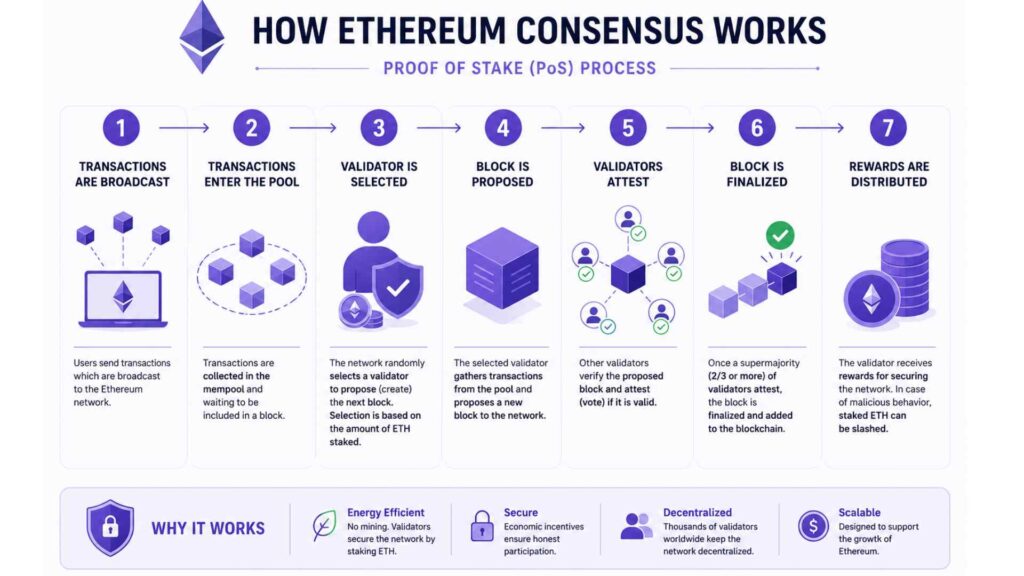
However, Ethereum relies on a different kind of mechanism to verify transactions. It migrated to proof-of-stake in 2022, meaning that transaction verifiers can only verify transactions (and earn rewards) if they stake some ETH as collateral (which is confiscated for bad behavior).
Further, Ethereum has smart contracts, which means many transactions can be automated. These transactions are typically:
- Peer-to-peer auto-payments.
- DeFi Transactions such as lending, staking, borrowing, pool deposits, yield farming, swapping, bridging, etc.
- Transactions originating from decentralized applications.
- Auctions
- Prediction markets
Why is Ethereum called a Layer-1 Chain?
Ethereum is called a layer-1 chain because it has everything it needs to run its blockchain on its own. Layer-1 chains have their own blockchain, their own EVM, and their own consensus mechanism.
Typically, layer-2 chains are dependent on Layer-1s for authenticity, security, and infrastructure.
What’s Inside Ethereum?
Ethereum isn’t just a single object; it is the system of systems that makes it possible for users to use decentralized finance without the need for any central authority. This is also the reason why Ethereum is called the “Internet of Decentralized Finance”.
Ethereum Blockchain
The main component of the entire ecosystem is the Ethereum blockchain, which acts as the foundation of the entire system. It is this blockchain that ensures that every activity on Ethereum takes place through genuine rules and regulations. It protects users from external attacks, finds and eliminates violators, deters hackers, and allows everyone to use Ethereum seamlessly.
The Ethereum blockchain started as a proof-of-work chain, similar to Bitcoin, but due to its high energy usage, had to switch to a more energy-efficient proof-of-stake consensus mechanism (explained in the infographic above).
Addresses
Addresses form the core of user existence in Ethereum (or in any blockchain). Each user is assigned an address when they set up any wallet. In Ethereum, each user is assigned an address which is equivalent to a bank account number in traditional finance. These addresses are operated using private keys, which are similar to passwords.
Ethereum has two types of addresses: externally owned and smart contract addresses. Externally Owned Addresses (EOA) are those which are assigned to individual users, and Smart Contract addresses are assigned to smart contracts which are used in DEXs, dApps, DeFi, etc.
Validators
Validators verify transactions initiated by users either through peer-to-peer transactions or when they interact with smart contracts to perform transactions like lending, borrowing, staking, liquidity farming, etc.
dApps
dApps are decentralized applications on Ethereum. They are similar to mobile apps, but since they exist on the Ethereum blockchain, they are available 24×7, a benefit of decentralization. These apps are powered by the Ethereum Virtual Machine.
Smart Contracts
Smart contracts are automated code that executes transactions, be it routine payments, auctions, dApp transactions, DeFi transactions, NFT whitelisting, or any other.
In Ethereum, smart contracts are written in the Solidity language.
ETH Cryptocurrency
ETH or Ether is the primary token of Ethereum and is used to pay for transaction fees, although in the near future, it will be possible to pay gas fees in any ERC-20 token. The token is also used as a primary asset across all Ethereum layer-2 blockchains.
Many people mistakenly believe that ETH is an ERC-20 token, but it is not. ETH was created in 2015, long before the introduction of the ERC-20 token standard. The ERC-20 version of ETH is called Wrapped ETH (wETH).
ERC-20 Tokens
ERC-20 is a token standard used to create DeFi-compliant cryptocurrencies on the Ethereum blockchain and within the Ethereum ecosystem.
Although it is not a mandatory standard, but those who violate it, have the risk of making their token incompatible with other tokens in DeFi, resulting in possible lack of adoption.
Examples of ERC-20 tokens include BNB, Shiba Inu, Chainlink, and Base.
Other Tokens
Besides ERC-20, there are other token standards on Ethereum, such as ERC-721 (used for NFTs) and ERC-1155 (used for fungible NFTs).
Ethereum Virtual Machine
The Ethereum Virtual Machine is a virtual computer that powers the entire Ethereum blockchain and all the EVM-dependent chains such as Shibarium. It draws computing power from the validator nodes, pools it, and runs the Ethereum client on it.
Since it is decentralized, the loss of any validator does not take the EVM offline, making it always available. This was one of the first instances of decentralized computing.
Top Ethereum Alternatives
Although Ethereum
BNB Chain
BNB is the largest Ethereum competitor by on-chain dApps and tokens. The chain was derived from Ethereum and was created by Binance to provide self-custody and DeFi features for its users. It has negligible transaction fees due to its backing by Binance.
The reason why users like me prefer BNB Chain is that it provides one of the highest levels of security, has a very high number of pegged assets (supports cross-chain assets in its chain), and has ultra-low fees.
BNB, however, loses to Ethereum in terms of decentralization (Ethereum’s 1 million validators vs BNB’s 21) and in terms of on-chain assets ($180 billion in Ethereum vs ).
Solana
Solana is an independent layer-1 blockchain created by Anatoly Yakovenko. It is a high-capacity chain tested to process around 65,000 transactions per second. The chain is preferred for its high power and supports all kinds of dApps and DeFi.
Solana also loses to Ethereum in terms of decentralization (it has around 400 validators) and on-chain assets (Solana has $50 billion worth of assets).
Frequently Asked Questions
Is Solana an Ethereum Killer?
No, Solana is not a direct competitor for Ethereum. The former is suited to high-speed applications, while Ethereum is preferred due to its security.
Disclaimer: Information provided on Ethereum News is for purely educational purposes and does not constitute investment or trading advice under any circumstances. Kindly consult your financial advisor before investing or trading in crypto markets.